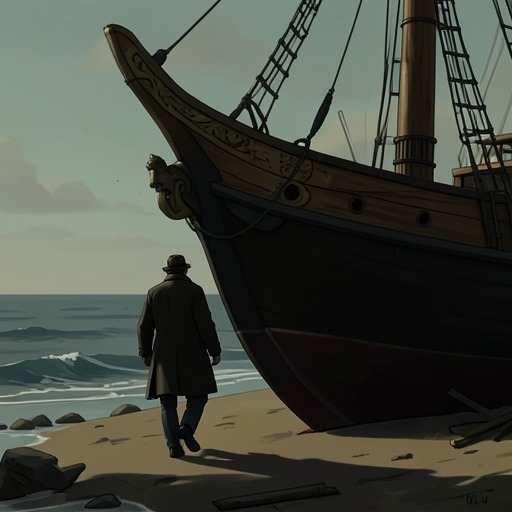
Norwegian captain
Finnegans WakeThe Norwegian captain is a shipboard counterpart to Kersse in an episode that makes a tailoring bargain the prelude to a voyage. Their exchange moves from an attempt to arrange clothing to a completed transaction and the captain’s departure by sea; its unstable multilingual phrasing makes commerce, negotiation, and movement part of the same comic action.
Encounter and Setting
The scene begins when Kersse draws out a model associated with the captain and approaches him aboard ship. The narrative locates their meeting amid nautical equipment and language, including the captain’s capstan, while its distorted, shifting words make the terms of the encounter difficult to separate from the surrounding play of translation.
The Tailoring Bargain
The captain recognizes the language of the proposed trade and answers that tailoring is available. Kersse describes a garment to be made for a woman, specifying a pair of trousers patterned after a cassock. The exchange proceeds through gestures and materials: he spits into his fist, measures the raw cloth, stakes his pledge, and tugs at his sleeve. These actions give the negotiation a physical sequence even as the surrounding language keeps its exact terms unstable.
The bargain is treated as settled: Kersse declares the arrangement good enough, and the captain turns to hail the lugger. The scene’s practical details—cloth, pattern, pledge, and vessel—connect the making of clothing to the commercial and maritime movement that follows.
Departure and Narrative Significance
After the bargain, the Norwegian captain sails away. The passage expands that departure into a voyage across distant waters, naming Franz Josef Land and Cabo Thormendoso and describing a journey of forty days and forty nights. The ship’s movement gives the episode a definite outcome: the negotiation does not remain an isolated exchange but leads directly into departure and travel.
The captain’s brief role joins trade to circulation. Clothing is proposed, pledged, and accepted; the lugger is hailed; and the voyage carries the scene outward across named places. Elsewhere, the book repeatedly invokes prices, debts, and exchanges, but the captain’s episode is distinctive in making a tailoring bargain the hinge between a meeting aboard ship and an extended sea journey.